
Water Supply Planning
In 2006, Governor Rod Blagojevich issued Executive Order2006-01 directing the Illinois Department of Natural Resources (IDNR) to conduct statewide and regional water supply planning. Carrying out that order, the IDNR partnered with Tri-County and the Illinois State Water Survey (ISWS) in 2014 to begin regional water supply planning in the Middle Illinois Basin spanning LaSalle, Livingston, Marshall, Peoria, Putnam, Stark, and Woodford Counties.
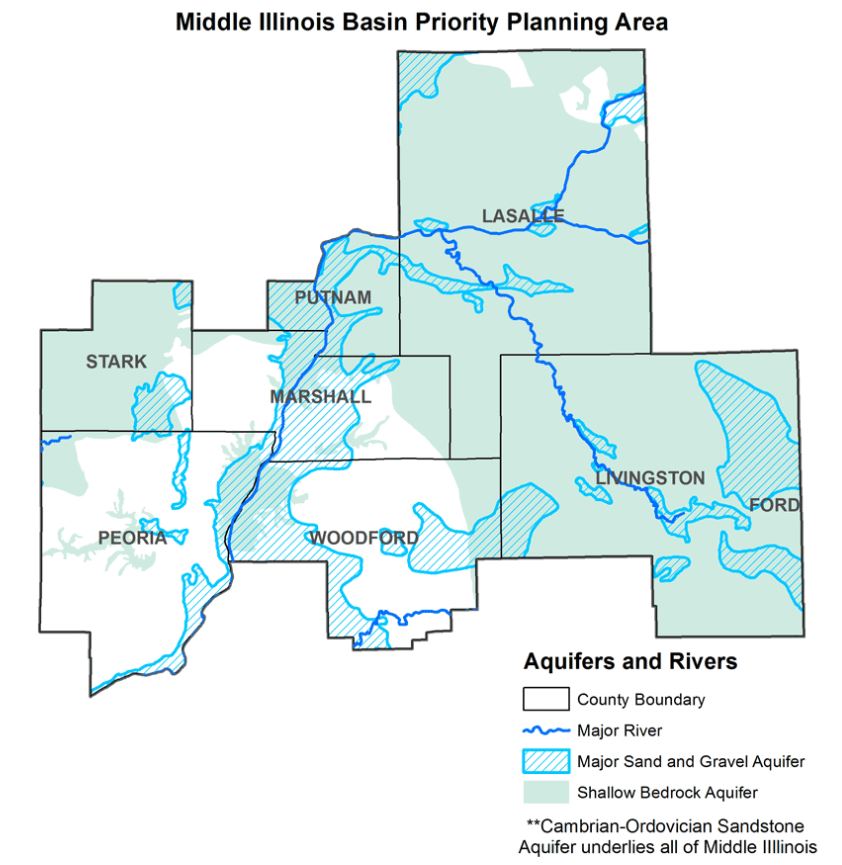
Water Supply Planning (WSP) in Illinois covers a wide variety of topics pertaining water in these seven counties.
WSP explores sources and quantity of both ground and surface water. This is compared with current and projected demand in the region to get a good picture of the environmental conditions in the region and how adequate they are for our water needs.
How we use the water we have access to is often just as important as understanding the quantity of water that we have access to. That’s why water management practices are also studied. Tri-county conducts analysis of a variety of municipal water systems, infrastructure such as stormwater management, and agricultural use to understand this aspect.
Conservation is another large part of Water Supply Planning. The purpose of this focus is to understand how out water supply and use interacts with the natural environment and how we can optimize our management practices to best protect our watersheds and wetlands.
Other topics including economic development, drought planning, and education and collaboration are considered in order to create a deeper understanding of Middle Illinois’ water supply environment
Environmental Conditions
Learn about the Commission, MPO, its history, and role in coordinating regional planning.
Management and Monitoring
View the counties, municipalities, and partner agencies that make up the Commission and collaborate on regional planning efforts.
Economic Development
Access information on board and committee members, including roles, structure, representation, and meeting materials.
Conservation
Access information on board and committee members, including roles, structure, representation, and meeting materials.